
Explore how Return to Player percentages, mathematical house edges, and volatility ratings shape the mechanics of modern pokies.
Before spinning the reels on any title, understanding how statistical models operate helps establish realistic gaming expectations.
The theoretical statistical calculation representing the proportion of all wagers returned over millions of rounds.
The built-in mathematical advantage retained by the game architecture across infinite simulated spins.
The risk profile indicating payout frequency and magnitude distribution during short-term play.
Algorithmic random number generators ensuring each individual outcome remains independent of past results.
Certified testing laboratories rigorously audit RNG algorithms across our partnered 91 game studios.
Specialised testing bodies such as BMM Testlabs and iTech Labs analyse statistical algorithms to verify true mathematical randomness.
Laboratories execute millions of automated cycles to confirm observed payout behaviour conforms to theoretical models.
Platforms deploy anti-fraud frameworks including iovation and ThreatMetrix to protect player accounts and transaction safety.
RTP is a theoretical calculation and never a guarantee for individual sessions. Always establish strict deposit boundaries and seek confidential assistance whenever needed.
Contact Gambling Help Online 1800 858 858 or register with the BetStop National Self-Exclusion Register for complimentary national support.
Return to Pokies LobbyWhat does RTP actually stand for?
Return to Player — the RTP meaning in pokies is a theoretical long-run payback percentage set by the game’s math model, not a live tracker of today’s payouts.
How is RTP different from pokies house edge?
They’re the same number viewed from opposite sides — 100% minus the RTP figure gives the house edge, so a 96% RTP pokie carries a 4% edge.
What’s a good RTP percentage to look for?
Average pokies RTP sits around 95–96%. High RTP pokies above 96.5% are generally considered strong, though that figure alone doesn’t account for volatility, which affects how it actually plays out session to session.
Does RTP mean I’ll get that percentage back every session?
No. RTP is a long-run average calculated across millions of spins, not a guarantee for any individual session, day, or player.
What’s the difference between RTP and volatility?
RTP vs volatility comes down to amount versus pattern. RTP measures how much comes back over the long run; volatility measures whether that comes back in frequent small wins (low volatility pokies) or rarer large ones (high volatility pokies).
How does the random number generator affect RTP?
Random number generator pokies decide each spin’s outcome independently, with no memory of previous spins. RTP is the long-run percentage those independent outcomes converge toward across millions of spins, not a promise about any specific sequence.
Is return to player Australia regulation different from other markets?
The standard is the same as other regulated markets — RTP figures here are independently tested and certified before a pokie goes live, so a stated RTP means the same thing regardless of which studio built the game.
Where can I check AUWin pokies RTP for a specific game?
On the information or paytable screen of each individual pokie, usually behind an “i” icon before spinning. That figure can vary by studio and version, so check the specific title rather than assuming a platform-wide number.
Does a higher RTP mean a better pokie?
Not necessarily. Online pokies RTP is one factor among several — a lower-RTP, low-volatility title can suit some sessions better than a high-RTP, high-volatility one, depending what a player wants from the session.
Table of Contents
Pokies RTP Explained: How AUWin’s Return to Player Numbers Actually Work
Pokies RTP explained in one line: it’s the theoretical percentage of every dollar wagered that a pokie is programmed to pay back to players over the long run. This is where AUWin Casino breaks it down properly — the actual math behind the number, not just the definition.
One scope note first. This article covers RTP calculations, house edge, volatility and long-term probability specifically. For plain definitions of general pokies terms like paylines, wilds or Megaways, the pokies glossary handles those separately — this page goes straight into the numbers instead of re-covering that ground.
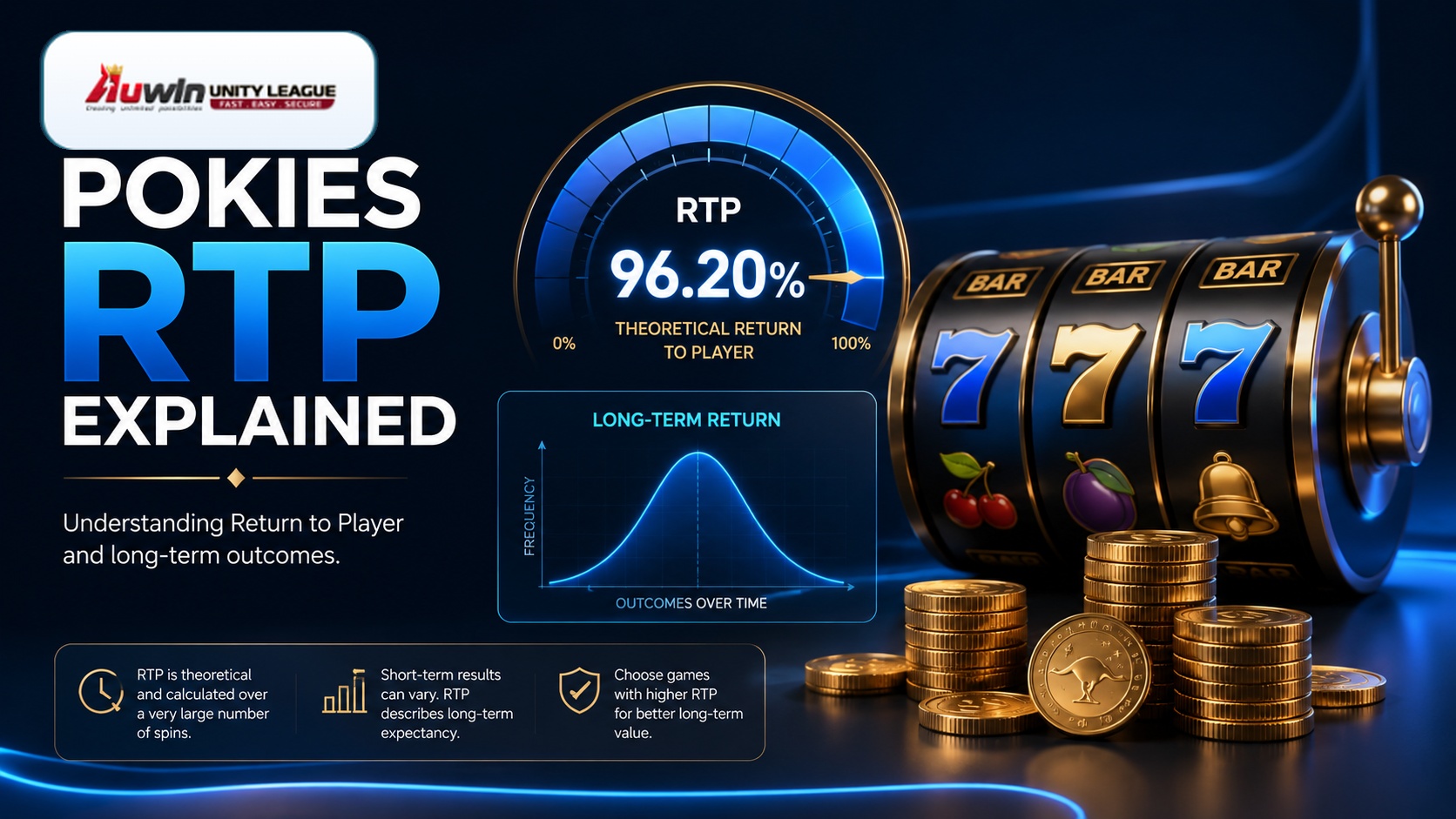
What Pokies RTP Actually Means
RTP stands for Return to Player. The RTP meaning in pokies is specific: it’s a theoretical, long-run percentage calculated by the game’s math model, not a live counter tracking what any individual machine has paid out today. A pokie listed at 96% RTP is programmed to return, on average, $96 for every $100 wagered across millions of spins — not $96 to any one player in any one session. That definition is the same standard used across every regulated market, including Australia.
How Pokies RTP Works: From Programmed Percentage to Real Spins
How pokies RTP works comes down to the game’s paytable and hit frequency, set before the game is ever released and locked into the math model that runs behind every spin. Developers build a probability table for every symbol combination, assign each one a payout, and run the combined math millions of times in simulation until the long-run percentage converges on the published figure. Nothing about how pokies RTP works changes session to session — the percentage is fixed at the software level, identical whether the pokie has been live for one day or ten years.
What does change spin to spin is the random number generator, covered further down — RTP is the mathematical ceiling the RNG’s outcomes converge toward, not a guarantee about any individual sequence of spins.
Return to Player Australia: Why the Number Gets Published at All
Return to player Australia disclosure isn’t optional for a properly licensed platform — RTP figures are checked and certified by independent testing labs before a pokie goes live, and the same standard applies to every AUWin pokies title regardless of studio. These rules exist so a stated RTP figure means the same thing everywhere it’s advertised, rather than being a marketing number a studio can set however it likes.
RTP Percentage Ranges: Low, Average and High RTP Pokies
RTP percentage varies more than most players expect — anywhere from the high 80s up into the high 90s depending on the title and studio. Average pokies RTP across a typical online library sits somewhere in the 95–96% range, though that’s a rough industry benchmark rather than a number any single operator guarantees across every game.
High RTP pokies, generally anything above 96.5%, tend to get more attention in review round-ups, but a higher number alone doesn’t tell you how a game plays — a low online pokies RTP title with strong volatility can still deliver a better session than a high-RTP, low-volatility one, depending what a player actually wants from a session.
Pokies House Edge: The Number Behind the Number
Pokies house edge is simply RTP inverted — subtract the RTP figure from 100% and the difference is the house edge. A pokie running at 96% RTP carries a 4% house edge; a pokie at 92% RTP carries an 8% house edge. That number is what actually funds the platform over the long run, and it’s why RTP is worth checking before choosing between two similar titles, even though it says nothing about what happens in any single session.
RTP vs Volatility: Two Numbers, Two Different Jobs
RTP vs volatility is the single most confused comparison in this whole topic, and they’re not measuring the same thing. RTP is about how much comes back over the long run; volatility is about how that money arrives — in frequent small wins or rarer large ones.
Low volatility pokies pay smaller amounts more often, which suits a longer, steadier session on a fixed budget. High volatility pokies pay less often but hit bigger when they do, suiting a player who’s comfortable with longer dry spells for a shot at a bigger swing. A game can combine any RTP with any volatility level — a high-RTP title can still be high volatility, and a lower-RTP title can still be low volatility.
Random Number Generators and Long-Term Probability
Random number generator pokies are the mechanism that actually decides every spin’s outcome, independent of every spin before or after it. Every AUWin pokies title runs on RNG technology audited by BMM Testlabs and iTech Labs, the same two independent labs that certify RTP figures across the platform.
This is also where long-term probability gets misunderstood. Random number generator pokies have no memory — a pokie that hasn’t paid a bonus in 500 spins is exactly as likely to trigger one on spin 501 as it was on spin one. RTP is a statement about millions of spins in aggregate, not a countdown toward a win, and treating it as one is the most common misreading of the number.
AUWin Pokies RTP: What to Check Before You Play
AUWin pokies RTP figures are listed on the information screen of each individual title, usually accessible from an “i” or paytable icon before spinning. Because RTP can vary between versions of the same game across different studios, checking that number on the specific title in front of you — rather than assuming a franchise-wide figure — is the only way to know the real one. The full AUWin pokies library lists titles from every partner studio, each with its own published RTP.
A Note on Responsible Play
Understanding all of it — RTP, house edge and volatility — doesn’t change the underlying math, and no amount of knowledge about long-term probability shortens the house edge on any individual session. This page exists to help you choose a game that matches how you want to play, not to suggest an edge that doesn’t exist. Players who want to set deposit, loss or session limits, take a cool-off, or register for self-exclusion can do so through the responsible gambling page, and Gambling Help Online is available free and confidentially on 1800 858 858.
Frequently Asked Questions
1. What does RTP actually stand for?
Return to Player — the RTP meaning in pokies is a theoretical long-run payback percentage set by the game’s math model, not a live tracker of today’s payouts.
2. How is RTP different from pokies house edge?
They’re the same number viewed from opposite sides — 100% minus the RTP figure gives the house edge, so a 96% RTP pokie carries a 4% edge.
3. What’s a good RTP percentage to look for?
Average pokies RTP sits around 95–96%. High RTP pokies above 96.5% are generally considered strong, though that figure alone doesn’t account for volatility, which affects how it actually plays out session to session.
4. Does RTP mean I’ll get that percentage back every session?
No. RTP is a long-run average calculated across millions of spins, not a guarantee for any individual session, day, or player.
5. What’s the difference between RTP and volatility?
RTP vs volatility comes down to amount versus pattern. RTP measures how much comes back over the long run; volatility measures whether that comes back in frequent small wins (low volatility pokies) or rarer large ones (high volatility pokies).
6. How does the random number generator affect RTP?
Random number generator pokies decide each spin’s outcome independently, with no memory of previous spins. RTP is the long-run percentage those independent outcomes converge toward across millions of spins, not a promise about any specific sequence.
7. Is return to player Australia regulation different from other markets?
The standard is the same as other regulated markets — RTP figures here are independently tested and certified before a pokie goes live, so a stated RTP means the same thing regardless of which studio built the game.
8. Where can I check AUWin pokies RTP for a specific game?
On the information or paytable screen of each individual pokie, usually behind an “i” icon before spinning. That figure can vary by studio and version, so check the specific title rather than assuming a platform-wide number.
9. Does a higher RTP mean a better pokie?
Not necessarily. Online pokies RTP is one factor among several — a lower-RTP, low-volatility title can suit some sessions better than a high-RTP, high-volatility one, depending what a player wants from the session.
That’s pokies RTP explained the way the math actually works — RTP, house edge, volatility and the random number generator behind every spin, not just a single percentage on a paytable. For general pokies terminology, the pokies glossary covers the rest.

The AUWin Casino Editorial Team researches and reviews online casino information for Australian players. Our coverage includes online pokies, live casino games, software providers, payment methods, promotions, mobile gaming and responsible gambling. Each guide is checked for clarity, accuracy and relevance before publication and reviewed whenever important details change.